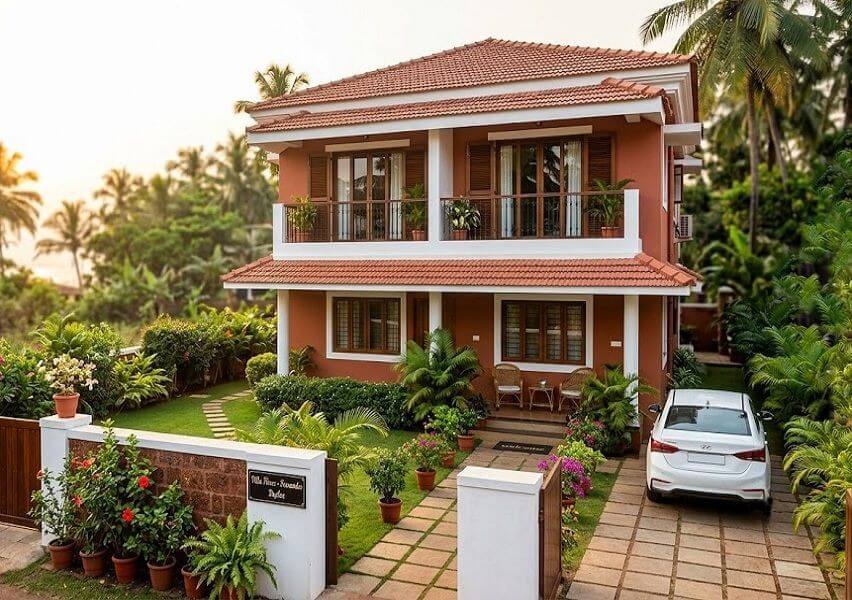
"That tropical villa looks picture-perfect on paper, but behind the coastal lifestyle lies a quiet tax: the hidden running costs nobody talks about until after you get the keys."
Purchasing a home in Goa is the ultimate achievement especially among those residing in the metropolitan cities such as Mumbai, Pune and Bengaluru.
When people think about purchasing a home in Goa – they often tend to get driven away by the emotional perspective more than the fiscal aspect.
The lure of the aquatic, the sussegad Goan lifestyle, abundant sea-food and the soothing green surroundings are just the few perks that play a major role in people purchasing properties in this Coastal Paradiso.
A home in Goa is considered as an investment, and every investment is associated with a several costs that make up the final price. Buyers have to make peace with several costs such as annual maintenance costs, utility bills, property taxes, monsoon repair and caretaker salaries and these charges go on for decades altogether.
Here in are mentioned some of these charges associated with the purchase of a property in Goa.
1. SOCIETY MAINTENANCE CHARGES:
For those buyers who purchase a property in a gated complex in Goa, maintenance charges come across as a rude awakening. There are three levels of maintenance charges that a buyer generally encounters depending upon the initial cost of the property:-
- Basic: A residential complex with security, common lighting and a standard elevator.
- Mid-segment: A residential society with pool, clubhouse and landscaped garden.
- Premium: A branded resort-style project with modern amenities.
Pro Tip: Property-owners are liable to pay maintenance charges for their apartment or commercial space whether they are in Goa or aboard.
What to check before you buy:
- Non-occupancy or absentee surcharges: As per societies act, some societies apply additional charges for units that are not self-occupied. Buyers need to research on these charges if they plan to rent out their property or keep it unoccupied.
- Amenity Load: These days residential projects are stuffed with amenities - a pool, generator, clubhouse and elevators. There is a cost associated with running these amenities and this costs are split among all the society members.
- Annual escalation: These maintenance charges are subject to increase on an annual or two-yearly basis at the discretion of the CHS.
2. UTILITY BILLS: SMALL WHEN YOU'RE AWAY, NOT ZERO:
- ELECTRICITY: Power supply in Goa is at the discretion of the state’s electricity department. The property owner if liable to pay minimum and fixed electricity charges even when the home is locked and there is no-occupancy. Regular usage of air-conditioning during humid summers can spike up the electricity bill from ₹ 3000/- to ₹ 5000/- per month.
- WATER: A residential society is equipped with a standalone water meter and water is supplied to all its units using this singular meter. Society members have to a pay a few hundred rupees as water charges. In case of extreme water shortage during dry months, residents have to book a water tanker that costs in the range of ₹ 800/-₹ 2500 per tanker.
- INTERNET, DTH AND GAS : These are essential utilities that are necessary for every home and there are steady costs associated with them.
3. PROPERTY TAX: THE SMALL NUMBER THAT SURPRISES OWNERS:
Property taxes are a significant cost that is incurred by the homeowner and it is levied either by the Village Panchayat or Municipal Corporation depending upon the location of the property.
- A House Tax is considered as an ultimate symbol of property ownership.
- Once the House Tax has been transferred from the builder’s name to the buyer’s name, the sale is considered as complete.
Pro Tip: Buyer compliance is advised
- Keep receipts: Homeowners need to pay their house tax regularly and acquire the receipts from the relevant departments. House tax paid receipts come in handy while doing a resale.
- Transfer of Ownership: Also buyers need to confirm that their home is assessed in their name after purchase.
4. MONSOON UPKEEP: GOA'S ANNUAL STRESS TEST:
The greatest litmus test that homeowners face is with the arrival of the Goan monsoon.. Homeowners need to be ultra-careful since this is what the monsoon does to their home:
- Water seepage, sunken slabs,
- Swollen doors and jammed drawers
- Clogged drains and overflowing sumps
- Frequent power fluctuations that tend to damage appliances
Steps To Be Carried Out
- ANNUAL PRE-MONSOON PREPARATION: Homeowners need to conduct terrace and drain checks, sealant touch-ups and pest and termite treatment.
- WATERPROOFING AND TERRACE TREATMENT: Waterproofing of the terrace and bathroom needs to be carried out before the monsoons to avoid seepage at least once in 5 years
- EXTERIOR AND INTERIOR REPAINTING: Goan monsoons are known to cause harm to house walls. It is advisable to carry out exterior as well as interior painting every 3-5 years since monsoon and salt air shorten paint life.
5. REPAIRS AND GENERAL UPKEEP:
Coastal homes in Goa demand a lot of repair and upkeep. Herein are some of the typical recurring items
- Air-conditioner servicing to be done twice a year
- Regular servicing of Refrigerators, washing machines, geysers, invertors and water pumps due to corrosion and power fluctuation.
- Repainting, polishing and re-sealing of wood, especially balconies and doors
- Pest control, including termites, ants and mosquito management
Final word: Goa is an extremely lucrative investment market for real estate. There are good returns to be earned by putting up a property on rent or resale.
All the same, real estate investment in Goa needs to be judged based on the total cost of ownership and not price per square meter. Property buyers also pay for salt, damp, seepage, servicing and absence on annual basis.